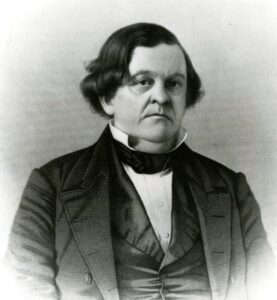
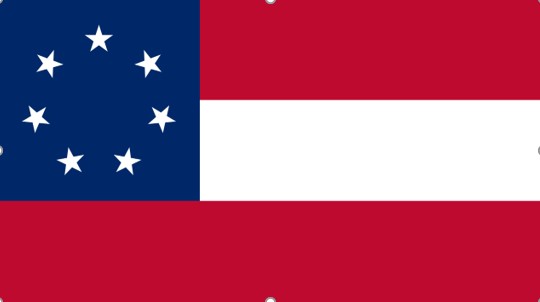
WASHINGTON’S BIRTHDAY: Outgoing President Howell Cobb, of the provisional Congress of the Confederate States, inaugurates nonpartisan (constitutionalist) former Senator Jefferson F. Davis, of the Confederate State of Mississippi, as provisional President of the Confederate States. Not once did Davis mention slavery in his inaugural address. Instead the new president spoke about the ideals of the unanimous Declaration (of Independence) and the Preambles to the Constitutions for the united and Confederate States:
Our present condition, achieved in a manner unprecedented in the history of nations, illustrates the American idea that governments rest upon the consent of the governed, and that it is the right of the people to alter or abolish governments whenever they become destructive of the ends for which they were established.
The declared purpose of the compact of [voluntary] Union from which we have withdrawn was “to establish justice, insure domestic tranquility, provide for the common defense, promote the general welfare, and secure the blessing of liberty to ourselves and our posterity;” and when, in the judgment of the sovereign States now composing this Confederacy, it had been perverted from the purposes for which it was ordained, and had ceased to answer the ends for which it was established, a peaceful appeal to the ballot-box declared that so far as they were concerned, the government created by that compact should cease to exist.
[added 3/12/2022]
WASHINGTON’S BIRTHDAY: President-elect Abraham Lincoln, of the united States, speaking at Independence Hall, in Philadelphia, Pennsylvania—the birthplace of secession from Great Britain—says:
I am filled with deep emotion at finding myself standing here, in this place, where were collected together the wisdom, the patriotism, the devotion to principle, from which sprang the institutions under which we live. … I have never had a feeling politically that did not spring from the sentiments embodied in the Declaration of Independence. I have often pondered over the dangers which were incurred by the men who assembled here, and framed and adopted that Declaration of Independence. I have pondered over the toils that were endured by the officers and soldiers of the army who achieved that Independence. … Now, my friends, can this country be saved upon that basis?
Now, in my view of the present aspect of affairs, there need be no bloodshed and war. There is no necessity for it. I am not in favor of such a course, and I may say, in advance, that there will be no bloodshed unless it be forced upon the Government, and then it will be compelled to act in self-defence.
NOTE: Although Lincoln used the word “country” here, the editors believe that he meant to use the word “nation,” in which a central government, with almost limitless power, treats its constituent states as mere enclaves, provinces, or sub-divisions of its greater self; as opposed to “Union,” which is a union of sovereign States under a federal system, with a central government whose powers are strictly limited by a respected Constitution.
[added 10/9/2026]
Subsequent Events:
Authority:
Provisional Confederate Constitution, Article II, Section 1 [Clause 6]
avalon.law.yale.edu/19th_century/csa_csapro.asp
References:
Matthew Galman, ed., The Civil War Chronicle, (New York: Crown, 2000), 35-37.
Steven Yates, “When is Political Divorce Justified?,” Secession, State and Liberty, David Gordon, ed., (New Brunswick, New Jersey and London: Transaction, 1988), 62.
Jefferson Davis’ First Inaugural Address
jeffersondavis.rice.edu/resources.cfm?doc_id=1508