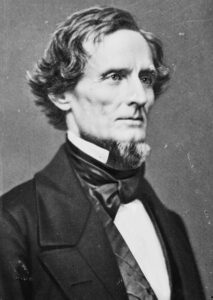
Democratic (constitutionalist) Senators Clement C. Clay, Jr. and Benjamin Fitzpatrick of Alabama, David Yulee and Stephen Mallory of Florida, and Jefferson Davis of Mississippi, all withdraw from the Senate. In his farewell address, Davis says,
It is known to Senators who have served with me here, that I have for many years advocated, as an essential attribute of State sovereignty, the right of a State to secede from the Union. Therefore, if I had not believed there was justifiable cause; if I had thought that Mississippi was acting without sufficient provocation, or without an existing necessity, I should still, under my theory of the Government, because of my allegiance to the State of which I am a citizen, have been bound by her action. I, however, may be permitted to say that I do think she has justifiable cause, and I approve of her act. …
· · · · · ·· · ·
A great man [John C. Calhoun] who now reposes with his fathers, and who has been often arraigned for a want of fealty to the Union, advocated the doctrine of nullification, because it preserved the Union. It was because of his deep-seated attachment to the Union, his determination to find some remedy for existing ills short of a severance of the ties which bound South Carolina to the other States, that Mr. Calhoun advocated the doctrine of nullification, which he proclaimed to be peaceful, to be within the limits of State power, not to disturb the Union, but only to be a means of bringing the agent before the tribunal of the States for their judgment.
Secession belongs to a different class of remedies. It is to be justified upon the basis that the States are sovereign. There was a time when none denied it. I hope the time may come again, when a better comprehension of the theory of our Government, and the inalienable rights of the people of the States, will prevent any one from denying that each State is a sovereign, and thus may reclaim the grants which it has made to any agent whomsoever.
I therefore say I concur in the action of the people of Mississippi, believing it to be necessary and proper, and should have been bound by their action if my belief had been otherwise; and this brings me to the important point which I wish on this last occasion to present to the Senate.
· · · · · ·· · ·
Then, Senators, we recur to the compact which binds us together; we recur to the principles upon which our Government was founded; and when you deny them, and when you deny to us the right to withdraw from a Government which thus perverted threatens to be destructive of our rights, we but tread in the path of our fathers when we proclaim our independence, and take the hazard. This is done not in hostility to others, not to injure any section of the country, not even for our own pecuniary benefit; but from the high and solemn motive of defending and protecting the rights we inherited, and which it is our sacred duty to transmit unshorn to our children.
NOTE: With the departure of the pro-slavery Senators, the anti-slavery remnant of the Senate was able to pass the Kansas Admission Act (YEA, 36; NAY, 16; ABSTAIN, 14).
[updated 10/4/2026]
Subsequent Events:
Authority:
Article I, Section 6 [Clause 1]
ccc-2point0.com/constitution-for-the-united-states
Article IV, Section 3 [Clause 1]
ccc-2point0.com/constitution-for-the-united-states
References:
Benjamin Perley Poore, ed., The Federal and State constitutions, colonial charters, and other organic laws of the United States, 2 volumes, (New York: B. Franklin, 1878), 1:610, 629.
“Today in History,” Orange County (California) Register, 21 January 2011, News:3.
U.S. Congress, Senate, 36th Congress, 2nd Session, Congressional Globe, (21 January 1861), volume 14, part 5, 489.
memory.loc.gov/cgi-bin/ampage?collId=llcg&fileName=055/llcg055.db&recNum=490
Jefferson Davis’ Farewell Address | The Papers of Jefferson Davis
jeffersondavis.rice.edu/archives/documents/jefferson-davis-farewell-address
The American Civil War (1860-1865)
www.thelatinlibrary.com/chron/civilwar.html
Chronology Of The American Civil War
civilwarhome.com/timeline.htm