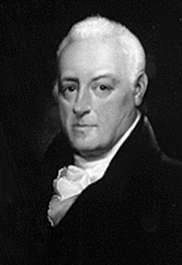
Robert Yates(?), a non-signing Delegate to the Constitutional Convention from New York, using the pseudonym “Brutus,” publishes an anti-federalist essay, further arguing against ratification of the proposed Constitution for the united States as there is provision for the House of Representatives to grow with that of the Electorate. In paragraphs two, four and six he writes,
… However fair an appearance any government may make, though it may possess a thousand plausible articles and be decorated with ever so many ornaments, yet if it is deficient in this essential principle of a full and just representation of the people, it will be only like a painted sepulcher—For, without this it cannot be a free government. …
· · · · · ·
… The firmest security against this kind of improper and dangerous influence, as well as all other, is a strong and numerous representation: in such a house of assembly, so great a number must be gained over, before the private views of individuals could be gratified that there could be scarce a hope of success. But in the foederal [sic] assembly, seventeen men are all that is necessary to pass a law. It is probable, it will seldom happen that more than twenty-five will be requisite to form a majority. …
· · · · · ·
… The people of this state will have very little acquaintance with those who may be chosen to represent them. …
NOTE: Although the identity of “Brutus” is not known for sure, many scholars believe him to have been Robert Yates, an Associate Justice of the New York Supreme Court.
[restored 9/27/2021]
Former Delegate Arthur Lee, to the united States in Congress assembled, using the pseudonym “Cincinnatus” publishes an anti-federalist essay attacking the pro-ratification speech of James Wilson. In paragraph one he warns:
[B]y ratifying the constitution, as the convention proposed it, the people will leave the liberty of the press, and the trial by jury, in civil cases, to the mercy of their rulers–that the project is to burthen them with enormous taxes, in order to raise and maintain armies, for the purposes of ambition and arbitrary power–that this power is to be vested in an aristocratic senate, who will either be themselves the tyrants, or the support of tyranny, in a president, who will know how to manage them, so as to make that body at once the instrument and the shield of his absolute authority.–Even the Roman Emperors found it necessary to have a senate for this purpose. …
[added 7/24/2026]
Subsequent Events:
References:
“Reply to Wilson’s Speech ‘Cincinnatus’ [Arthur Lee] V,” from The Debate on the Constitution, two volumes, Bernard Bailyn, ed., (New York: Library of America, 1992), 1:114.
Murray Dry, The Anti-Federalist: An abridgement, from The Complete Anti-Federalist by Herbert J. Storing, ed., (Chicago and London: University of Chicago Press, 1985), 127, 128, 129, 130
Brutus IV
www.infoplease.com/primary-sources/government/anti-federalist-papers/brutus-iv
The Prophetic Antifederalists | Mises Institute
mises.org/library/prophetic-antifederalists