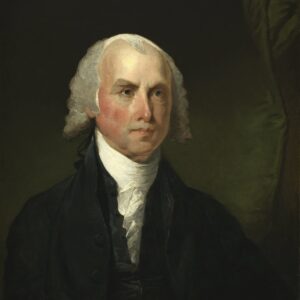
James Madison, a former Delegate to the Constitutional Convention from the Commonwealth of Virginia, using the pseudonym “Publius,” publishes “Federalist #55.” In paragraph three he argues for an ever-increasing membership in the House of Representatives to keep the influence of special interests to a minimum:
The charges exhibited against it are, first, that so small a number of representatives will be an unsafe depositary of the public interests; secondly, that they will not possess a proper knowledge of the local circumstances of their numerous constituents; thirdly, that they will be taken from that class of citizens which will sympathize least with the feelings of the mass of the people, and be most likely to aim at a permanent elevation of the few on the depression of the many; fourthly, that defective as the number will be in the first instance, it will be more and more disproportionate, by the increase of the people, and the obstacles which will prevent a correspondent increase of the representatives.
James Madison, “The Total Number of the House of Representatives,” from The Debate on the Constitution, two volumes, Bernard Bailyn, ed., (New York: Library of America, 1992), 2:202-07.