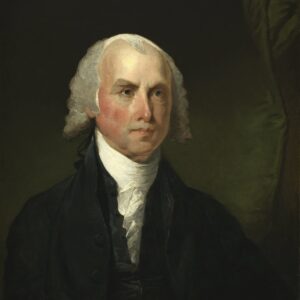

James Madison, a former Delegate to the Constitutional Convention, from the Commonwealth of Virginia, using the pseudonym “Publius,” publishes “Federalist #62,” reasserting the importance of electing the Senate by the State legislatures. In paragraphs 3 and 15 he writes,
It is equally unnecessary to dilate on the appointment of senators by the State legislatures. Among the various modes which might have been devised for constituting this branch of the government, that which has been proposed by the convention is probably the most congenial with the public opinion. It is recommended by the double advantage of favoring a select appointment, and of giving to the State governments such an agency in the formation of the federal government as must secure the authority: of the former, and may form a convenient link between the two systems.
The internal effects of a mutable policy are still more calamitous. It poisons the blessings of liberty itself. It will be of little avail to the people, that the laws are made by men of their own choice, if the laws be so voluminous that they cannot be read, or so incoherent that they cannot be understood: if they be repealed or revised before they are promulg[at]ed, or undergo such incessant changes, that no man who knows what the law is to-day, can guess what it will be to-morrow. [emphasis added]
[restored 12/7/2024]
Delegate Tench Coxe, of the Commonwealth of Pennsylvania, using the pseudonym “A Pennsylvanian” writes a pro-federalist essay stating the proposed Constitution for the united States will protect religious liberty. In paragraph one he writes,
… The most careful examination of the powers to be vested in Congress will not enable us to discover one clause, by which the federal legislature can interfere in religious affairs. The Convention have carefully avoided investing them with any authority of that nature, in my opinion, from the purest and wisest reasons. First, because they are matters in which neither national governments nor foreigners (with whom they are to treat) have ever interfered from the begining [sic]of the world, but at the expence of the rights of a part, or the peace of the whole of the people: Secondly, because the United States having no national church either in present existence or in contemplation, it is evidently one of those domestic points, in which the intervention of the federal government cannot ever be necessary or proper: And lastly, because, I presume, much the greater part of the Convention were averse to the interference of human authority in forming laws concerning matters of conscience, remembering that even the omnipotent Creator of the universe has granted free will to man. … Here, we cannot omit to observe, is an highly important and influential power, remaining with the state governments, which Congress can in no way exercise: And tho’ we must consider it as passing beyond the due bounds of human authority, and as trespassing on, the rights of conscience and free will of man, which God himself has vouchsafed to bestow, yet certain it is that several of the state governments do at this time inconsiderately exercise this power.
NOTE: This was written before the “Bill of Rights” was added to the Constitution.
[added 7/31/2026]
Subsequent Events:
Authority:
Articles of Confederation, Article XIII
ccc-2point0.com/Articles-of-Confederation
References:
Brian Doherty, “The Decay of Democracy,” Reason, January 1993, 38.
Michael Maharrey, with Michael Boldin, The Other Federalist Papers: Tench Coxe, (Irvine, California: By the author, 16755 Von Karman #200 PMB705, 2024), 97-99.
Federalist No 62 – The Avalon Project
avalon.law.yale.edu/18th_century/fed62.asp
Federalist No. 62 – Wikipedia
en.wikipedia.org/wiki/Federalist_No._62