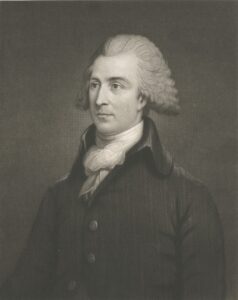

Delegate Tench Coxe, of the Commonwealth of Pennsylvania, using the pseudonym “A Pennsylvanian” writes a pro-federalist essay dismissing the notion that the adoption of the proposed Constitution for the united States will lead to the annihilation of the State governments. In paragraphs two, three, five, six, and nine he writes,
[O]ur general government should be confederated, so it is now incumbent on me to answer those arguments which have been adduced to prove the proposed constitution will annihilate the legislative, executive and judicial powers of the several states. This I believe is the great ground, on which all the fears of the opposition rest in Pennsylvania, and throughout the union. .
… So far is this from being the case, that there is but one single branch of revenue placed out of the reach of the state legislatures—that arising from trade, which is the least of all connected with liberty, as it is extra territorial, and requires no dangerous force to ensure its execution. But even on this the state legislatures have a complete check, in the power of chusing the Senators, whose voices are necessary to a commercial act. If the [f]ederal Representatives of the people bring forward a bill of this kind, tending to diminish the constitutional and due weight of the separate governments, the Representatives of the state legislatures (the Senators) can say, it shall not be enacted; and this, moreover, will apply to every revenue law Congress shall attempt. Whence it appears, that Congress possess not an unlimited, but a controulable, power over the purse; while no act of Congress, nor of any other power, can prevent the state legislatures from imposing any duty, excise or tax upon any intraterritorial object, provided the application of the money is to state purposes. But the several states will possess more or less of independent revenues and resources, to which the powers of Congress cannot be extended. …
· · · · · · ·
The power of the sword, say the minority of Pennsylvania, is in the hands of Congress. My friends and countrymen, it is not so, for the powers of the sword are in the hands of the yeomanry of America from sixteen to sixty. The militia of these free commonwealths, entitled and accustomed to their arms, when compared with any possible army, must be tremendous and irresistible [sic] Who are these militia? are they not ourselves. Is it feared, then, that we shall turn our arms each man against his own bosom. Congress have no power to disarm the militia. Their swords, and every other terrible implement of the soldier, are the birth-right of an American. What clause in the state or federal constitutions hath given away that important right. It is said, Congress can order the militia of Georgia to New Hampshire! The gentlemen might have gone further, and said, they might order the militia of Maryland to march over the surface of the Chesapeak. The latter would be obeyed as soon as the former. These extravagancies operate against all power. The legislature of Pennsylvania may constitutionally order their citizens to pay in taxes one half, or even the whole, value of their estates, by the very clause which vests them with the power of providing for the real and evident exigences of the state government. Further, the power of the sword, even so far as it is placed in the hands of Congress, is subject to the controul of the state legislatures, for they name one branch of the federal government (the Senate) without whom no military officers can be appointed, no monies granted, no armies raised, no navies provided. The state governments also have “the authority of training the militia, and appointing all the officers. The constitution, instead of providing a standing (or permanent) army, takes care that it shall not be standing, shall not continue, for it declares it shall find itself absolutely unprovided at the end of every two years. …
The legislature of each state must possess, exclusively of Congress, many powers, which the latter can never exercise. The state governments can prescribe the various punishments that shall be inflicted for disorders, riots, assaults, larcenies, bigamy, arson, burglaries, murders, state treason, and many other offences against their peace and dignity, which, being in no way subjected to the jurisdiction of the federal legislature, would go unpunished. They alone can promote the improvement of the country by general roads, canals, bridges, clearing rivers, erecting ferries, building state houses, town halls, court houses, market houses, county gaols [jails], poor houses, places of worship, state and county schools and hospitals. They alone are the conservators of the reputation of their respective states in foreign countries, by having the entire regulation of inspecting exports. They can create new state offices, and abolish old ones; regulate descents of lands, and the distribution of the other property of persons dying intestate; provide for calling out the militia, for any purpose within the state; prescribe the qualifications of electors of the state, and even of the federal representatives; make donations of lands; erect new state courts; incorporate societies for the purposes of religion, learning, policy or profit; erect counties, cities, towns and boroughs; divide an extensive territory into two governments; declare what offences shall be impeachable in the states, and the pains and penalties that shall be consequent on conviction; and elect the federal senators. These things and many more can always be done by the state legislatures. How then can it be said, that they will be absorbed by the Congress, who can interfere in few or none of those matters, though they are absolutely necessary to the preservation of society and the existence of both the federal and state governments. .
· · · · · · ·
[I]nstead of the annihilation of the state governments by the federal government, Congress must not only refrain from injuring them, but that they must most carefully attend to the preservation of their internal peace, and the exercise of their separate and indispensible [sic] powers, as the only means which can preserve the federal government itself from disorder and annihilation. Hence we find they have pledged themselves to apply the whole powers of the union to maintain in each state a free or republican government.
[added 7/25/2026]
James Madison, a former Delegate to the Constitutional Convention from the Commonwealth of Virginia, using the pseudonym “Publius,” publishes “Federalist #58,” advising that the membership of the House of Representatives should be kept to a low number, lest the triumph of “passion over reason.” In paragraph two he writes,
Ignorance will be the dupe of cunning, and passion the slave of sophistry and declamation. The people can never err more than in supposing that by multiplying their representatives beyond a certain limit, they strengthen the barrier against the government of a few. Experience will forever admonish them that, on the contrary, AFTER SECURING A SUFFICIENT NUMBER FOR THE PURPOSES OF SAFETY, OF LOCAL INFORMATION, AND OF DIFFUSIVE SYMPATHY WITH THE WHOLE SOCIETY, they will counteract their own views by every addition to their representatives. The countenance of the government may become more democratic, but the soul that animates it will be more oligarchic. … [emphasis in the original]
[restored 12/7/2024]
Subsequent Events:
Authority:
Articles of Confederation, Article XIII
ccc-2point0.com/Articles-of-Confederation
References:
Michael Maharrey, with Michael Boldin, The Other Federalist Papers: Tench Coxe, (Irvine, California: By the author, 16755 Von Karman #200 PMB705, 2024), 88-95.
Federalist No 58 – The Avalon Project
avalon.law.yale.edu/18th_century/fed58.asp
Federalist No. 58 – Wikipedia
en.wikipedia.org/wiki/Federalist_No._58