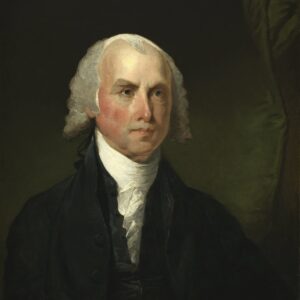
James Madison, a former Delegate to the Constitutional Convention, from the Commonwealth of Virginia, using the pseudonym “Publius,” publishes “Federalist #43,” explaining the purpose of the Guarantee Clause (Article IV, Section 4). In paragraph two he writes, “In a confederacy founded on republican principles, and composed of republican members, the superintending government ought clearly to possess authority: to defend the system against aristocratic or monarchial innovations.”
Also, in paragraph 29 he discusses the delicate issue of dealing with those States that refuse to ratify the Constitution for the United States:
[A]lthough no political relation can subsist between the assenting and dissenting States … the moral obligations will remain uncanceled [sic]. The claims of justice, both on one side and on the other, will be in force, and must be fulfilled; the rights of humanity must in all cases be duly and mutually respected; whilst considerations of a common interest, and above all, the remembrance of the endearing scenes which are past, and the anticipation of a speedy triumph over the obstacles to reunion, will, it is hoped, not urge in vain moderation on one side, and prudence on the other. [Emphasis in the original]
[updated 7/24/2026]
Delegate Tench Coxe, of the Commonwealth of Pennsylvania, using the pseudonym “A Freeman” writes a pro-federalist essay listing ten reasons the Constitution for the United [S]tates will prevent federal overreach: .
“Congress, under all the powers of the proposed constitution, can neither train the militia, nor appoint the officers thereof.
“They cannot fix the qualifications of electors representatives, or of the electors of the electors of the President or Vice-President.
“In case of a vacancy in the senate or the house of representatives, they cannot issue a writ for a new election, nor take any of the measures necessary to obtain one.
“They cannot appoint a judge, constitute a court, or in any other way interfere in determining offences against the criminal law of the [S]tates, nor can they in anyway interfere in the determinations of civil causes between citizens of the same [S]tate, which will be innumerable and highly important.
“They cannot elect a President, a Vice-President, a Senator, or a federal representative, without all of which their own government must remain suspended, and universal Anarchy must ensue.
“They cannot determine the place of chusing senators, because that would be derogatory to the sovereignty of the [S]tate legislatures, who are to elect them.
“They cannot enact laws for the inspection of the produce of the country, a matter of the utmost importance to the commerce of the several [S]tates, and the honor of the whole.
“They cannot appoint or commission any [S]tate officer, legislative, executive or judicial.
“They cannot interfere with the opening of rivers and canals; the making or regulation of roads, except post roads; building bridges; erecting ferries; establishment of [S]tate seminaries of learning; libraries; literary, religious, trading or manufacturing societies; erecting or regulating the police of cities, towns or boroughs; creating new [S]tate offices; building light houses, public wharves, county gaols, markets, or other public buildings; making sale of [S]tate lands, and other [S]tate property; receiving or appropriating the incomes of [S]tate buildings and property; executing the [S]tate laws; altering the criminal law; nor can they do any other matter or thing appertaining to the internal affairs of any [S]tate, whether legislative, executive or judicial, civil or ecclesiastical.
“They cannot interfere with, alter or amend the constitution of any [S]tate, which, it is admitted, now is, and, from time to time, will be more or less necessary in most of them.”
[added 7/24/2026]
At the Massachusetts Ratifying Convention, Jeremiah Pierce cautions against Congress being allowed to impose a Direct tax (“a tax exacted directly from the person on whom the ultimate burden of the tax is expected to fall, such as property, income, gift, inheritance, and poll taxes.” –– Webster’s Unabridged Dictionary) during peace time:
But these arguments to me are not conclusive; for, if our enemies know they do not use such powers except in a war, although granted to them, what will be the difference if they have the powers only in the time of war? But, Mr. President, if Congress have the powers of direct taxes, in the manner prescribed in this section, I fear we shall have that mode of taxation adopted, in preference to imposts and excises [i.e. Indirect taxes (“a taxes exacted indirectly from a person other than the one on whom the ultimate burden of the taxes are expected to fall.” [Such as tariffs on imports, or excises]–– Webster’s Unabridged Dictionary Unabridged Dictionary)]; and the reasons of my fears are these: When the impost was granted to Congress in this state, I, then being a member of court, well remember the gentlemen in trade, almost with one consent, agreed that it was an unequal tax, bearing hard on them; for, although it finally was a tax on the consumer, yet, in the first instance, it was paid by persons in trade; and also that they consumed more than the landed interest of dutied articles; and nothing but necessity induced them to submit to grant said impost, as that was the only way Congress could collect money to pay the foreign debt, under the regulations they were then under; and I fear part of this state’s members in Congress, when this Constitution is adopted, will resume their own opinion, when they can lay direct taxes; and, as Rhode Island has always been against an impost, and as they have an equal representation in the Senate, and part of Connecticut will be interested with them, and the Southern States having no manufactures of their own, and consuming much more foreign articles than the Northern, it appears to me, we are not certain of availing ourselves of an impost, if we give Congress power to levy and collect direct taxes in time of peace.
[added 7/24/2026]
Subsequent Events:
Authority:
Articles of Confederation, Article XIII
ccc-2point0.com/Articles-of-Confederation
References:
Michael Maharrey, with Michael Boldin, The Other Federalist Papers: Tench Coxe, (Irvine, California: By the author, 16755 Von Karman #200 PMB705, 2024), 53-60.
Irwin A. Schiff, The Great Income Tax Hoax: Why You Can Immediately Stop Paying This Illegally Enforced Tax, (Hamden, Connecticut: Freedom Books, 1985), 418-19.
Thomas G. West, Vindicating the Founders: Race, Sex, Class, and Justice in the Origins of America, (Lanham, Maryland: Rowman & Littlefield, 1997), 157-58.
William M. Weicek, The Guarantee Clause of the U.S. Constitution, (Ithaca, New York and London: Cornell University Press, 1972), 66.
Federalist No 43 – The Avalon Project
avalon.law.yale.edu/18th_century/fed43.asp
Federalist No. 43 – Wikipedia
en.wikipedia.org/wiki/Federalist_No._43