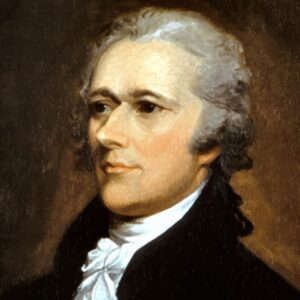
At the Constitutional Convention, Delegate Alexander Hamilton, of New York, speaks for an extended period of time praising the unwritten British constitution as the “best in the world.” Hamilton goes on to propose his own eleven-point absolutist constitution, numbers one, three, four, seven, ten and eleven of which feature:
- A bicameral legislature with unlimited authority: to pass legislation on any subject whatsoever;
- A lower house elected for three-year terms;
- An upper house elected for life, by Electors elected by freeholders, would have the sole power to declare war;
- A national executive elected for life by Electors elected by freeholders, and have an absolute veto over all legislation;
- The national legislature would have absolute control over State courts, appointment of State governors, and an absolute veto over State legislation.
- Permanent control of the State Militias by the national executive.
NOTES:
- The Convention was so horrified by this proposal that Hamilton never mentioned it again.
Also during his address, Hamilton expressed his opinion of the common man:
All communities divide themselves into the few and the many. The first are the rich and well born, the other the mass of the people. The voice of the people has been said to be the voice of God; and however generally this maxim has been quoted and believed, it is not true in fact. The people are turbulent and changing; they seldom judge or determine right. Give therefore to the first class a distinct, permanent share in the government. They will check the unsteadiness of the second, and as they cannot receive any advantage by a change, they therefore will ever maintain good government. Can a democratic assembly, who annually revolve in the mass of the people, be supposed steadily to pursue the public good?
[updated 7/18/2026]
Subsequent Events:
Authority:
Articles of Confederation, Article XIII
ccc-2point0.com/Articles-of-Confederation
References:
“Chronology of Events, 1774-1804,” from The Debate on the Constitution, two volumes, Bernard Bailyn, ed., (New York: Library of America, 1992), 2:1051.
Howard Zinn, A People’s History of the United States, (New York: HarperPerennial, 1980), 95.
Avalon Project – Madison Debates – June 18
avalon.law.yale.edu/18th_century/debates_618.asp
Guided Readings: Federalists and Jeffersonians | Gilder Lehrman Institute of American History
www.gilderlehrman.org/history-resources/teaching-resource/guided-readings-federalists-and-jeffersonians